BIG SIGNAL 18BS-270
High-performance VHF/UHF dual-band directional antenna for DX and satellites
The BIG SIGNAL 18BS-270 is a dual-band directional Cubical Quad antenna developed for operators looking for higher gain, greater directivity and improved weak-signal capability on VHF and UHF.
Its architecture combines 6 active elements on 144 MHz and 12 active elements on 432 MHz on a single boom, integrating two optimized directional systems designed to provide high performance for both terrestrial DX and satellite communications.
Bands: 144 / 432 MHz
Active elements: 18
VHF: 6 elements on 144 MHz
UHF: 12 elements on 432 MHz
Configuration: Full-wave Quad elements
Type: Dual-band directional antenna
Recommended use: Terrestrial DX / Satellites / Weak signals
Two bands. 18 elements. One boom.
The concept behind the 18BS-270 is to integrate two high-performance directional systems on the same structure, optimizing the behavior of each band while minimizing interaction between VHF and UHF as much as possible.
The result is an antenna designed for operators who want to take their VHF/UHF station one step further: greater directivity, improved weak-signal capability and a highly selective radiation pattern.
What makes the 18BS-270 different?
• 18 active elements
A configuration featuring 6 elements for 144 MHz and 12 elements for 432 MHz, designed to provide high directional performance on both bands.
• Full-wave Quad elements
Unlike the open half-wave elements commonly used in many Yagi antennas, the 18BS-270 uses full-wave closed loops, taking advantage of the characteristics inherent to Quad geometry.
• High gain and directivity
Its high number of elements helps concentrate radiation toward the desired direction, an important advantage for terrestrial DX and weak-signal operation.
• Excellent front-to-back performance
A selective directional pattern helps reduce signals and interference arriving from unwanted directions, improving the station's effective signal-to-noise ratio.
• Designed for weak-signal reception
The combination of directivity, rejection outside the main lobe and closed-loop elements is especially valuable when the objective is to pull weak signals out of the noise.
• One structure for VHF and UHF
Provides a high-performance directional antenna for both bands without requiring two separate antennas to be installed on the mast.
Designed to perform where signals are weak
On VHF and UHF, just a few dB can separate a perfectly workable signal from one that barely rises above the noise floor. The 18BS-270 is designed precisely for these situations, where gain, directivity and rejection outside the main lobe can make the difference.
Terrestrial DX and satellite communications
For terrestrial DX, its gain and high directivity make it possible to concentrate the system toward the desired direction and work long-distance stations when propagation conditions allow.
For satellite operation, the VHF/UHF combination provides both bands on a single directional structure, making it an especially interesting solution for stations looking for more gain than a portable handheld antenna.
The difference of a Cubical Quad
A Quad and a Yagi represent two different approaches to directional antenna design. The 18BS-270 uses full-wave closed-loop elements to provide a particularly interesting combination of gain, directivity and signal-to-noise performance.
The objective is not simply to have more elements, but to make the complete antenna work as an optimized system designed to hear better, reject unwanted signals more effectively and reach farther.
When you want to go one step further on VHF/UHF.
The BIG SIGNAL 18BS-270 combines 18 active elements, high directivity and two bands on a single structure for operators looking to get more from their station in terrestrial DX and satellite communications.
BIG SIGNAL – Less noise. More signal.
 ES
ES EN
EN


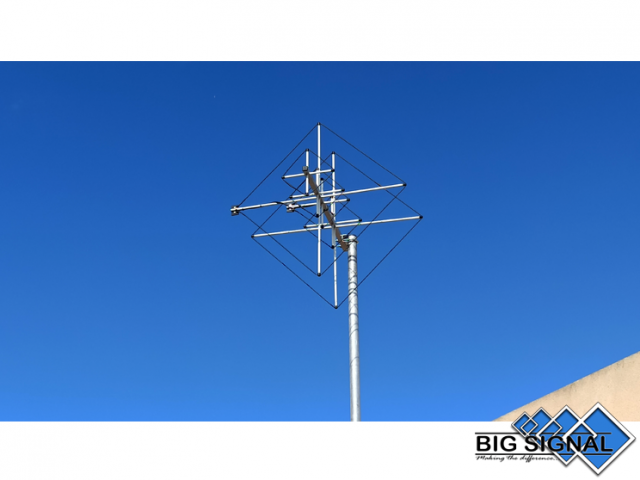
El primer fin de semana de julio montamos la antena en plena meseta segoviana y con el muro de la sierra de Guadarrama detrás. Contentos con el rendimiento de la Big Signal 18BS-270 en el concurso Atlántico V-UHF.